Showing posts with label media. Show all posts

Thursday, March 08, 2007

INDIAN MASS MEDIA - Keynote Oct 19 2007

SACREDMEDIACOW

and the Centre for Media and Film Studies (SOAS)
presents:

INDIAN MASS MEDIA
AND THE POLITICS OF CHANGE

One-day conference for Postgraduates & Early Career Researchers,
School of Oriental and African Studies (SOAS)
Saturday, 19 October, 2007

Keynote Speaker: Dr John Hutnyk (Goldsmiths, University of London)

Advisors:
Prof Annabelle Sreberny (Centre for Media and Film Studies, SOAS)
Dr Mark Hobart (Centre for Media and Film Studies, SOAS)
Dr Rachel Dwyer (Dept of Languages and Cultures of South Asia, SOAS)

Call for Papers:

India has been the focus of much attention in the international media in the recent years. Rhetoric concerning its rapid economic growth, spearheaded by its IT industry and its burgeoning middle classes, suggest that something new and significant is taking place. Something is changing, we are told: India is shining; the elephant is rising; the 21st century will be an Indian century. Even a recent election campaign was debated around this image. India was/was not shining, with disastrous results for the leading political party in power.

What unites many of the debates concerning such re-imaginings of India is the notion of change and its different ramifications. Elections, commentators, drawing room debates and activists all cut their teeth around this complex notion. Who, it is debated, benefits from change? Who is left out from these fantasies of progress and economic growth? Do such re-imaginings really reflect the complex economic reality of large parts of Indian populations 'somewhere out there'? In any case, what is certain is that 'change' has now become the new articulating principle par excellence when we speak about India and its contested future.

One of the crucial sites where such debates take place is the Indian mass media: its newspapers, TV channels, advertisements and burgeoning online communities. It is also the loci, we argue, where the politics of change are most visibly played out and that needs to be carefully looked at in order to understand the complex reality of India today. It is important to note here that we believe the nation state is one of categories that needs to be critically investigated when we look at India and change and therefore include the wider Indian diaspora into our definition of what contemporary India is. With this in mind, The Politics of Change conference aims to bring together researchers looking at Indian films and media and interested in the question of change.

We therefore now welcome abstract for papers and presentations of 20 minutes each from post-graduate and early career researchers. Specifically, we are inviting papers that would broadly address the following questions:
● How is change imagined in different forms of Indian media? How are the press, television, film and online communities involved in this imagining? How do different media differ in how they imagine change?
● What kind of day-to-day practices are deployed to articulate these imaginings of change? What kind of verbal and visual images is used towards such imaginings and how do they differ between the media? What are the differences between the English-speaking and the vernacular media? What about the diasporic media?
● What are the politics of such imaginings? Who are such articulations thought to benefit? Who in turn do they disarticulate? What is the political economy of imagining change?
● How have these articulations changed historically? Can we trace historical precedents to such current imaginings? What are the similarities? What are the differences?
● Is there something distinctive about how this change is imagined in (India as opposed to other rapidly-developing countries such as China?)? What do these similarities and differences tell us about Indian media and society?
Abstracts, including a brief biography, should be emailed to papers@sacredmediacow.com no later than May 15, 2007. These will then be discussed with our advisors and team, and we will get back to you by the 15th of June. Please do let us know in advance if you would like us to organize projectors, or any other special requirements you might have.

The conference is jointly is organized by SACREDMEDIACOW, an independent student-led research centre on Indian media and the Centre for Media and Film Studies at the School Of Oriental and African Studies. Having said that, SACREDMEDIACOW is not really a centre for India media research (perhaps a periphery of Indian media research would be a more appropriate title), but more of a Collective. Either way, being both practitioners as well as academics interested in the India media, one of our key aims to build bridges between academics and media practitioners globally. Therefore, a significant portion of the activities around the conference will also take place on our website
http://www.sacredmediacow.com.

Our aim is to include the people we talk about when we research Indian media as much as possible in the dialogue and debates through the possibilities allowed by new technologies: by distributing conference material online, by creating an online platform where the questions raised can be debated during the conference and by allowing distance participation as much
as possible through teleconferencing, video broadcast and other such means.

Please also visit our working space for the conference at http://www.sacredmediacow.com/wikindia)
where many of these ideas will be collectively worked out.

For further information, please email the SACREDMEDIACOW collective:
collective@sacredmediacow.com
or:
Somnath Batabyal, som@soas.ac.uk
Meenu Gaur, meenu@soas.ac.uk
Matti Pohjonen, matti.pohjonen@gmail.com
Angad Chowdhry, angad.chowdhry@gmail.com

Tuesday, February 27, 2007

Sacred Media Cow


From Somnath over on on "Sacred Media Cow" [SACREDMEDIACOW is an independent postgraduate collective on Indian media research and production at the School of Oriental and African Studies (SOAS) at the University of London]:
Oh Calcutta

Folks, been away from active blogging for a while. Apologies. The PhD writing and thinking alongwith other activities been taking its toll. Hopefully back now.

My thesis concerns itself with two urban news centres, Calcutta (I still cant bear to do away with the colonial imageries) and Mumbai. Been reading a bit about both the cities lately and a book by John Hutnyk called The Rumour of Calcutta is a quite fascinating account of the city and deconstructs the myths around this “city of extremes” created through the views and notions of representations, from foreign travellers on missions of mercy staying at a cheap tourist lodge to travel guides, books and films.

I have also been logging how the media in recent times has been portraying the city. By all accounts, Calcutta has finally come of age. It is the city on the mend. The government is being applauded, the Chief Minister felicitated. Right wing Conservative Shekhar Gupta in Indian Express speaks and applauds the Indian Left and its erudition, the Politburo and its concerns. Sagarika Ghose cant stop gushing in her interview with Buddha Babu. Protests by “nay sayers” are brushed aside as the crumbling city wakes up to a new dawn. These are not my metaphors. So what’s going on.

It is very much like the errant child who has come home. Give it it’s just rewards, bring it into the fold, hand out the sops and make sure it feels welcome. The media house, the corporate entities cant stop falling over each other to felicitate Buddhadev Bhattacharya’s “coming to sense” wisdom and merging Calcutta with the other metros; long live the Left, so long as it can be managed.

Wednesday, August 30, 2006

Shine Media


Shine Media:

"Orange Life - Latest Issue
Summer 2006: Space for Ourselves
Features:
Revolutionary Tourism
When Nepal does appear in our newspapers and on TV, it's usually to show Himalayan landscapes and Sherpas, complete with references to Shangri-La (the earthly paradise found in a lost Tibetan valley, imagined in James Hilton's 1933 novel, Lost Horizon). Recent political turmoil in Nepal has however brought other images to the forefront: strikes and curfews, the King forced to reopen parliament, a new prime minister, protests in the streets. But in either case, the representation of Nepal raises questions about our perceptions of faraway places, filtered through the lens of our media-driven preconceptions."

- a commissioned piece in the Canadian mag "Orange Life" I did ages back - for some reason I have had a lot of trouble trying to get copies delivered. If they did not seem so nice (Canadians!) I'd be thinking they were deserving of a visit from some tough Mountie type who'd go round their place and duff em up with his sharp hat.
.

Monday, July 17, 2006

No news from lebanon?

Yehia writes - Monday, 17 July 8.10pm:
"dear friends.

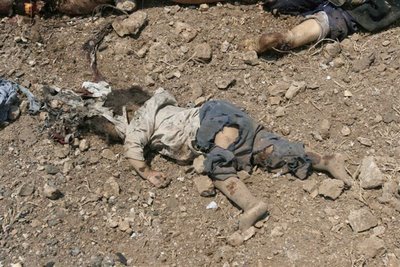
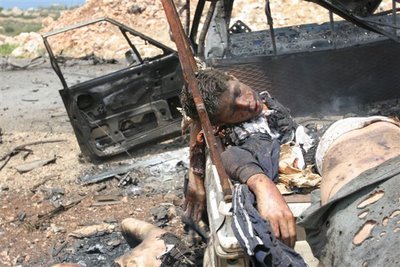
I am crying and shaking from head to toe with rage and grief. so forgive me for sending this. But everyone should know what is happening in lebanon. And this will not happen through the mainstream corporate media.
The following message was sent by Hanady Salman, an editor at a local lebanese newspaper As-Safir:


Dear friends and colleagues ,

You will all have to excuse me for sending this. It's pictures of thebodies of babies killed by the israelis in South lebanon. They are all burnt. I need your help. I am almost certain these pictures won't bepublished in the West, although they are associated press pictures. I need your help exposing them if you can. The problem is these are people who were asked to leave their village , Ter Hafra , this morning , within two hours , or else.... So those who were able to flee went to the closer UN base wherethey were asked to leave. I think that after the Qana massacres in 1996 when civilians were bombed after they took shelter in UN headquarters , the UN does not want to be responssible for the lives of civilians.


A FEW MINUTES AGO , the Israeli asked the people of Al Bustan village in the south to evacuate their homes. I am afraid massacares will keep happening as long as Israeli actions are uncheked.

Please help us if you can

Hanady Salman "
.

Monday, July 03, 2006

Geert Lovink on Delhi Sunderam Sarai etc.


Latest reports from the Nangla Maanchi eviction (Dehli settlement)filed under Uncategorized , geert @ 01:03
Disturbing reports came in last night from Delhi, thanks to Ravi Sundaram from Sarai, who sent the personal accounts, written over the past days about the eviction of the Nangla Maanchi settlement where one of Sarai’s media labs (called cybermohalla) was based. I have saved some of the messages on my pages. A few days ago I posted a letter about this on my blog (see below). You can follow the latest news and activities on their own blog. How the elites imagine Delhi you can see here.

March 28th, 2006
Blog about endangered Delhi settlementfiled under Uncategorized , geert @ 02:03
Monica Narula of the new media centre Sarai in Delhi has written the following call about the eviction of a settlement in Delhi where one of Sarai’s media labs (called Cybermohalla) is based:
Dear friends,
Over last 35 years we have seen many an internal dislocation of habitations and life worlds within the city of Delhi. This is something that started with high intensity from the early 70s. Now the process of this internal dislocation has become intense and harder.
Nangla Maachi is a 30 year old habitation. It was made by its inhabitants over this period. It is along the river bank and next to Pragati Maidan (Progress Grounds). It has now become valuable real estate as it is prime land for new urban development fairly close to the centre of the city.
The process of its dislocation has, therefore, begun.
In Nangla Maachi Sarai/Ankur had set up a cybermohalla lab two years ago. Many practitioners have been through the lab.
Over these two years, diaries have been written by the lab practitioners and many of the entries have been about life in Nangla. These diary entries are also a way to stubbornly remind us all that Nangla was made into a lively, heterogeneous habitation by countless people’s efforts, and needs to be remembered for this creative act of making and finding ways of living together.
A recent entry reads - “Packing up and leaving from Nangla has begun.” The diary is now a record of a contested terrain of the violence of dislocation.
We have set up a blog in both English and Hindi, to share with a wider public the various diary entries of the practitioners. Do visit it, read it, circulate it, share it and link it further. Your comments and stories will be very valuable.
English language blog:http://nangla.freeflux.net/
Hindi language blog:http://nangla-maachi.freeflux.net/
More postings from the practitioners will be made. A countdown to yet another disappearance of a self-organised urban space has begun.
bestMonica ....